"Equality will always feel uncomfortable for those who once benefited from inequality." - Michael S. Kimmel, The Gendered Society.
I feel this quote rings true. I wish to pursue a career within psychology. Equality and positions of advantage/disadvantage is something I would like to study further in regards to our behaviour when we feel we are in these positions.
Unknown (2014) Available from: http://twoheadedgorilla.tumblr.com/post/81477047561/equality-will-always-feel-uncomfortable-for-those [Accessed 10th February 2015].
Showing posts with label gender. Show all posts
Showing posts with label gender. Show all posts
Tuesday, 17 February 2015

Tuesday, 27 January 2015
Feminist theories on gender inequality.
Feminists on gender inequality.

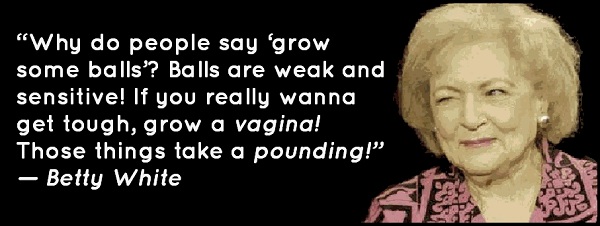
[anons.] (2011) Betty White qoute. [online image]
available from: http://www.bigfishink.com/wp-content/uploads/2011/10/cartoon-Betty-White-on-Balls-jpg.jpg [accessed 18th january 2015].
Shulamith Firestone refers to women as being less
privileged due to biology. Men and women are biologically different, an
undeniable fact, which firestone explains results in a division through a
sexual class system. Women’s reproductive organs give them an instant
disadvantage, having to bear the responsibility of menstruation and childbirth.
These burdens result in over dependency on males during pregnancy and the
nurturing of the child, which Firestone believes “produce[s] unequal power relationships”
(2000). This explanation holds value as
men do not have the same physical responsibility to reproduce that women endure
but if this the true explanation for gender inequality then the first stage of
overcoming it would to gain equality in terms of biology, which in today’s
society seems impossible. Firestones theory is also not applicable to all
societies and cultures, where men hold primary responsibility for child care
and nurture.
Due to having a male dominated society our social
construction is a vital part of controlling females and encouraging males to
prevail. Through primary socialisation females and males are moulded into their
gender roles, taught how to behave act and feel (Fulcher and Scott, 2001). Through
my own experience these are further encouraged through secondary socialisation
where schools teach children what their aims should be in life after education.
Media is also a major influence within secondary socialisation. From a young
age you are exposed to media every day. Whether it be television, music or
magazines. Girl’s magazines focus on hair, make up and sex; whilst boy’s
magazine focus on cars, science and the rough and tumble. You cannot deny that
this media exposure creates an underprivileged realm for women when they are
taught from so young that they must judge themselves through their image and
the type of male they can acquire. Women are taught that their main attributes
to offer the world is their reproductive organs, nurturing skills and the
ability to please a man. Men are taught that women are beneath them, as they
have always had an advantage. Although they may deny the knowledge of this our
selfish human nature will typically not challenge something helping us to
achieve. This theory can hold validity to most females within the culture of
the 21st century in the UK. To be able to gain inequality, our whole
society and culture must be stripped down and recreated which seems a very
unlikely occurrence right now (maybe in the future?).
Language is supposedly the intellect that divides
humans from other mammals – but does it also divide males and females? Karen
Atkinson (1993) explains that sexism is predominantly visible within today’s
language, whether it be verbal or written. The language that we so unobservable
use was created by men and is dominated by men. Terms such as ‘Mankind’ are
used frequently to refer to all gender of human but unexplainably uses the word
‘man’. Women are being oppressed through this ‘manmade’ language that our
patriarchal society has empowered men with. With such contrasting labelling
such as ‘stud-slag’ and such vulgar and offensive terms used to describe the
vagina, it is undeniably sexist.
Overall each theory does hold some validity and
explanation for gender inequality, although the only obvious way to achieve
true equality will either be through years (or maybe centuries) of change or a
revolution.
References
Haralambos, M., Holborn, M. and Heald, R. (2000) Sociology: Themes and Perspectives. Hammersmith:
HarperCollins Publishers Limited. P 139-140.
Atkinson, K. (1993). Language and Gender. In:
Jackson, S. Womens Studies: A reader. Hemel Hampstead: Harvester
Wheatsheaf. p403-407.
Fulcher, J. and Scott, J.(2001) Sociology. New York:Oxford University
Press Incorporated. Pg 154-155
Wednesday, 7 January 2015
Nature v Nurture
The Development of Gender:
Nature Vs Nurture
Gender is a label defined by
masculine and feminine attributes identified through different social and
cultural characteristics (Browne, K. 2006). The
development of gender is something that is widely discussed and debated. The
main two arguments involve the sociobiological theory: that gender can be explained
in biological terms; and the social constructionist theory - that gender has
been learnt from society (Giddens 1993). This essay will discuss these two
theories, there strengths, limitations and evaluate them in their approach to
the development of gender.
Haralambos and Holborn (2000)
explain that E.O. Wilson based the development of socio-biology around the
theory of evolution by Charles Darwin, furthermore it was applied to gender by
David Barash (1979). The sociobiological theory believes that all behaviour of
humans and animals can be explained through three biological means: Endocrinology
(study of hormones), genetics and evolution. “Socio-biology refers to the
application of biological principles in explaining the social activities of all
social animals including human beings” (Giddens, A. 1993. Pg 35). Biology has
proven that there are different levels of hormones produced in the body dependent
upon sex, and there is a direct link between behaviour and hormones. This has
been further shown in Baren-Cohen’s experiments, where results have shown that levels
of testosterone during pregnancy can cause different behaviours in males and
females by the age of one (Marsh, I. et
al pg 220). Further, this experiment has been backed up by Udry (1995) in
his studies on hormones. It has also been documented before but ethological
studies on primates. Most of these biological studies and experiments do have scientific
evidence, however they are mainly performed on animals (Udry, R.J. 1995),
meaning they lack validity as they cannot always be applied to human gendered
behaviours. Although there may be experiments on humans giving evidence to
support the biological theory it is not always applicable in every society and
culture. The sociobiologist theory also limits the variation within their evidence as
other social and cultural factors are not taken into account, for example, in
tribes where women are more dominant, males have the responsibility of rearing
children (Haralambos & Holborn 2000). By underestimating the effect that
socialisation may have on gender, studies can be hindered with the belief that
their theories are always correct.
The social constructionist
theory follows the belief that all social behaviour can be explained through
social construction. The constructionist’s believe that gender is a social
construct and has been developed through socialisation (Giddens, A. 1993). A
major influence to this is gender roles. Gender roles are the expectations set
by society that determine the way we act, feel, think and behave. Within each culture
these roles are varied due to the differences in ideologies. From the moment of
birth (or even before with the technology of today) gender roles are set into
place. Within most western societies gender differences are poignantly visible
through observable behaviours and social identities. Primary socialisation is
the first stage of this ‘gender teaching’, starting early on within the family.
When children are born, families, consciously or unconsciously, influence their
child’s gender through gender specific names, toys, clothes and behaviours
(Marsh, I et al 2009). This theory
has been backed up by studies on the treatment of gender specific babies. A child
was dressed in pink and given a female name which led to the adults describing
the child as having feminine traits and encouraged to play with ‘female toys’.
When the same baby was dressed in blue and given a male name it was described
as having masculine traits and was encouraged to play with ‘male toys’
(Giddens, A. 1993). This experiment shows that gender is enforced through
socialisation early on in life. Haralambos and Holborn (2000) explain that the family
is not the only the part of gender learning, secondary socialisation occurs
within education and other agencies. With same sex schools, and gender aimed
classes, an individual’s identity in extremely influenced to make them fit in
to their society. Whilst in this stage of secondary socialisation peer groups
are also a major influence. Through all parts of social life gender has been
taught to the individual, e.g. family education health religion. Anybody who
does not follow these gender ‘norms’ that are set by the society in which they
exist have been as far as labelled as ‘abnormal’ by psychologists. With it even
resulting in people being medicated and receiving therapy to ‘fit in’ and meet
these norms. To reiterate a weakness of the socio-biologist theory, social constructionists
also hinder their studies and experiments by only looking for supporting
evidence rather than anything that may be contradicting to their belief. This
theory also does not take into account the social and cultural differences,
where some cultures may not have so many gender traditions (Haralambos &
Holborn. 2000).
These two theories may seem
very contrasting but there are small similarities between each. With socio-biologists
explaining gender through nature and socio-constructionists through nurture,
there is no evidence given that gender may be a choice, it is either forced
upon us or written within our human DNA, everything is predetermined. Along with
these similarities there are also differences: Sociobiological may seem to be a
more scientific approach but as the evidence provided cannot be applied to
every human being, the social constructionist theories may hold a stronger argument.
To contradict this, something intangible is not something that is so easily
backed up by scientists, who tend to disregard social science, with the belief
that science is physical.
The contribution of nature
nurture evidence provided by these theories is hard to deny. However it is
difficult to apply either one of these theories globally due to the lack of
external validity within their experiments. The socio-biologists may be able to
provide evidence to their theory, but it is difficult to ignore the fact that
socialisation unquestionably encourages and manifests gender and its roles
within society.
Word count: 990
References
| Anderson, M.L. and Witham,
D.H. (2010) Thinking About Women: Sociological
Perspectives on Sex and Gender. 9th edition. Boston: Pearson
Education.
Browne, K. (2006) Introducing Sociology for AS Level 2nd ed.,
United Kingdom: Polity Press.
Fulcher, J. and Scott, J. (2011) Sociology 4th ed., United
Kingdom: Oxford University Press. Pg154-155
Giddens, A. (1993) Sociology, United Kingdom: Cambridge :
Polity Press.
Haralambos, M. and Holborn, M. (2000) Sociology: Themes and
Perspectives. London : Collins.
Illich, I. (1983) Gender, United Kingdom: London ; New York :
Marion Boyars.
Marsh, I., Keating, M. and Punch, S. (2009) Sociology: Making Sense
of Society 4th edition. United Kingdom: Pearson Education Limited.
Taylor, P. Richardson, J.
Yeo, A. Marsh, I. Troke, K. Pilkington, A. (1995) Sociology in focus. Ormskirk: Causeway Press Limited. Pg 125.
Turner, B., Abercrombie, N. and Hill, S. (2006) The Penguin
dictionary of sociology 5th edition. United Kingdom: Penguin Group.
|
Udry, J.R. (1995) Social Forces: Socilogy and Biology: What
Biology Do Sociologists Need to Know? North Carolina: The University of
North Carolina Press. 73 (4): pp 1267-1278.
Tuesday, 2 December 2014
Peer Teaching - Gender Roles
This is a video of my peer teaching presentation for Sex and
Gender studies in Sociology. My presentation explains how gender roles are
created by society through many aspects of social life including; family,
education and media. The presentation is a brief overview of Gender Roles,
although there is a lot more involved in the creation of these. I also include
a psychological view of how behaviour can be taught through conditioning.
 To make
my presentation more interactive I created a test for my peers using The
Bechdel Test (http://bechdeltest.com/).
The test involves movies that have to meet a certain criteria to pass - this
illustrates a gender bias. I recommend you have a look at this test as some of
the results can be quite surprising. Another way to try and make my
presentation more interactive was the use of music. The music I chose is I’m Just a Girl by No Doubt. The lyrics
of the song describe a girl who is sick and tired of being forced into the Gender
Roles her society is imposing on her. Check it out here: https://www.youtube.com/watch?v=PHzOOQfhPFg
To make
my presentation more interactive I created a test for my peers using The
Bechdel Test (http://bechdeltest.com/).
The test involves movies that have to meet a certain criteria to pass - this
illustrates a gender bias. I recommend you have a look at this test as some of
the results can be quite surprising. Another way to try and make my
presentation more interactive was the use of music. The music I chose is I’m Just a Girl by No Doubt. The lyrics
of the song describe a girl who is sick and tired of being forced into the Gender
Roles her society is imposing on her. Check it out here: https://www.youtube.com/watch?v=PHzOOQfhPFg
My reflection
I feel I delivered my presentation well, although I could have
done with having more notes to read off rather than reading from the slides as
this would have allowed me to engage the audience more. My voice is clear and
loud so the audience can hear me over the music played. If the presentation was
to be repeated I would attempt to not move my hands so much, as it shows my
nervousness and may distract the audience from focusing on the slides.
Bechdel, A. (n.d.) The
Bechdel Test. [online] Available: http://bechdeltest.com/
[accessed 23rd November 2014].
Friday, 28 November 2014
Glossary of sociological terms.
 |
|
AAAAAAAAXkU/R7T42SwYPcc/s1600/malefemale.jpeg
|
 |
|
thumb/1/11/A_TransGender-Symbol_Plain3.svg/480px-A_
TransGender-Symbol_Plain3.svg.png
|
Gender is not biological like sex. It refers to the different social and cultural characteristics that society has set to define us as male or female. This will vary through different societies and cultures (Fulcher, J and Scott, J. [2009] Sociology).
 |
|
|
Gender roles are the stereotypes and ideologies of how men
and women should think, act, feel and behave imposed by their society. An example
of this would be that men are supposed to be the breadwinner to the family by
producing financial support whilst the women are supposed to stay at home to
raise the family and maintain the household (Taylor, P. et al [1995] Sociology
in Focus).
 |
|
|
 |
|
incredibly-offensive-vintage-ads
|
 |
|
|

 |
|
http://www.news.cornell.edu/sites/chronicle.cornell/files/sexposter3-10.jpg
|
Sexuality refers to someone’s sexual preferences and what
they are attracted to. The most common are heterosexual (opposite sex), homosexual (same sex) and
bisexual (both sexes) (Fulcher, J and Scott, J. [2009] Sociology).
Fulcher, J. and Scott,
J.(2001) Sociology. New York:Oxford
University Press Incorporated. Pg 154-155
Taylor, P. Richardson, J. Yeo,
A. Marsh, I. Troke, K. and Pilkington, A. (1995) Sociology in focus. Ormskirk: Causeway Press Limited. Pg 125
A, Melissa (2007) 1950’s Gender Roles. [Online image] Available
from: http://www.funfacts.com.au/1950s-housewife/
[Accessed 19th November 2014].
Anons (2014) Gender of the day [Online image] Available from: http://genderoftheday.tumblr.com/post/99954283725/todays-gender-of-the-day-is-the-abstract-concept [Accessed 19th Novemebr 2014].
Anons (unknown) Shark Slayer. [Online image] Available from:
http://www.weirdnutdaily.com/7i1
[Accessed 19th November 2014].
DailyMail (2007) You mean a woman can open it? [Online
image] Available from: http://www.dailymail.co.uk/femail/article-496827/The-outrageously-politically-incorrect-adverts-time-equality-forgot.html
[Accessed 19th November 2014].
Pechey, P. (2011) I am? [Online
image] Available from: http://www.mindtheproduct.com/2011/10/i-am-a-product-manager/
[Accessed 19th November 2014].
Subscribe to:
Posts (Atom)